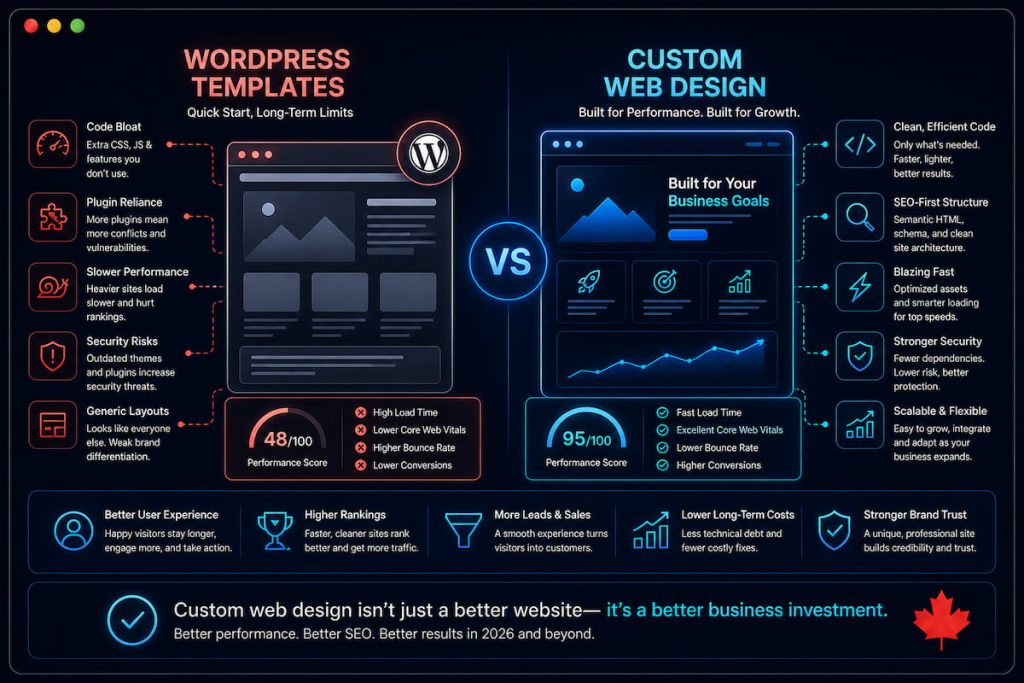
In 2026, a business website needs to do more than simply exist online. It needs to load fast, work well on mobile, support SEO, build trust, and make it easy for visitors to take action. This is where many WordPress templates start to show their limits.
Templates can be useful for a quick launch, especially for very simple websites. But when a business needs long-term performance, stronger search visibility, cleaner branding, and room to grow, custom web design usually provides a stronger foundation. The difference is not only how the website looks. The real difference is how the website is planned, built, optimized, and maintained.
For businesses that depend on leads, bookings, sales, or service inquiries, a custom website can be a better investment because it is built around real goals instead of forcing your business into a pre-made layout.
The Problem With Many WordPress Templates
WordPress templates are often built to serve many different industries at once. To make them flexible, they usually include extra layouts, scripts, animations, styling options, plugin support, and features that many websites never use. This can make the website heavier than it needs to be.
At first, a template may look like a simple and affordable choice. But over time, the website can become slower, harder to customize, and more dependent on plugins. Every new feature may require another plugin, another setting, or another workaround. This can create performance issues and make the website harder to manage.
Templates Are Built for Everyone
A template is not designed around your specific business, content, services, customers, or conversion goals. It gives you a starting point, but it may not give you the best structure. Many businesses end up changing the template so much that the final website becomes messy, inconsistent, and difficult to maintain.
Custom Design Is Built Around Your Business
Custom web design starts with your goals. What services do you offer? What questions do customers ask before contacting you? What pages need to rank? What action should visitors take next? These answers shape the layout, content structure, calls to action, and technical build.
This is why custom website design and development can create a stronger result than simply installing a ready-made theme and adjusting the colours.
Custom Web Design vs WordPress Templates
The difference between a custom website and a template becomes clearer when you compare the technical and business impact of both options.
| Area | WordPress Template | Custom Web Design |
|---|---|---|
| Code Structure | Often includes unused CSS, JavaScript, layouts, and features. | Built with only the structure and features the website needs. |
| SEO Foundation | Often depends heavily on plugins and theme settings. | Built with clean headings, semantic HTML, schema planning, and page structure. |
| Performance | Can become slower because of extra scripts, plugins, and theme bloat. | Can be optimized from the start for faster loading and better Core Web Vitals. |
| Mobile Experience | Usually responsive, but not always planned around real user behaviour. | Designed for mobile users, service flow, readability, and easy contact. |
| Scalability | New features often require more plugins or workarounds. | Can be built in a modular way so the website can grow over time. |
| Brand Identity | May look similar to many other websites using the same theme. | Designed around your brand, message, services, and market position. |
Why Performance Matters More in 2026
Website performance affects more than speed scores. It affects user experience, SEO, trust, and conversions. If your website loads slowly or feels delayed when visitors click buttons, open menus, or complete forms, people may leave before they contact you.
Google’s Core Web Vitals measure important parts of page experience, including loading performance, responsiveness, and visual stability. A clean custom build gives developers more control over these areas because unnecessary scripts, layout shifts, and plugin conflicts can be reduced from the start.
Templates Can Carry Code Bloat
Many templates load assets for features you may never use, such as sliders, animations, multiple layout systems, icon packs, extra fonts, and global styling. This can increase page weight and slow down important pages like your homepage, service pages, landing pages, and contact page.
Custom Websites Can Be Built Performance-First
A custom website can be built with a performance-first approach. That means optimized images, lightweight code, clean CSS, minimal JavaScript, strong caching, and better control over what loads on each page. For businesses that already have a slow site, website optimization can also help improve speed and usability without rebuilding everything immediately.
Custom Web Design Gives You a Better SEO Foundation
SEO is not only about adding keywords or installing an SEO plugin. A plugin can help with meta titles, descriptions, redirects, and sitemaps, but it cannot fully fix poor page structure, slow loading, weak internal linking, or messy HTML.
Custom web design allows the SEO structure to be planned from the beginning. This includes clear headings, useful service sections, internal links, optimized image use, schema planning, fast loading, and a layout that matches search intent.
Search Intent Can Shape the Page
Every important page should answer what the visitor is actually searching for. A service page should explain the service, who it helps, the common problems it solves, the process, trust signals, pricing direction, FAQs, and the next step. A custom layout makes it easier to build around this flow instead of forcing the content into a generic template section.
Technical SEO Can Be Built Into the Website
Technical SEO is easier when the website is built cleanly from the start. A custom build can support better crawlability, faster loading, clean URLs, structured data, optimized images, proper heading hierarchy, and stronger internal linking. IBWeb provides technical SEO services for businesses that need a stronger search foundation.
Custom Websites Are Easier to Scale
A business website often needs to grow. You may add service pages, location pages, landing pages, blog content, eCommerce features, automation, CRM integrations, booking tools, or custom forms. A template may handle some of this, but the more plugins and workarounds you add, the more fragile the website can become.
A custom website can be planned with future growth in mind. Instead of building only for launch day, the structure can support new content, new sections, and new features over time.
Templates Often Depend on Plugins
Plugins are useful, but too many plugins can create conflicts, slow loading, update problems, and security risks. Some websites become difficult to manage because each important feature depends on a separate plugin or third-party tool.
Custom Development Can Keep the Website Cleaner
With custom development, important features can be planned and built in a cleaner way. The website can use fewer unnecessary dependencies, better code organization, and a structure that is easier to maintain. This is especially useful for growing businesses that need long-term flexibility.
Security and Maintenance Are Easier With a Cleaner Build
Security is another reason businesses should think beyond the first launch. A website that relies on too many plugins, outdated themes, or unused features can become harder to protect. Every extra dependency needs updates, testing, and monitoring.
A cleaner custom build can reduce unnecessary risk by limiting what the website depends on. It does not remove the need for updates or maintenance, but it can make the website easier to keep stable over time.
Maintenance Should Not Be an Afterthought
Even a well-built website needs ongoing care. Updates, backups, security checks, speed reviews, and content improvements help keep the site working properly. For long-term stability, IBWeb offers website maintenance and support for business websites.
The Real Cost of Cheap WordPress Templates
A template may cost less at the beginning, but the long-term cost can be higher if the website becomes slow, hard to customize, difficult to rank, or expensive to fix. Many businesses start with a template and later pay for plugin cleanup, redesign work, speed optimization, layout fixes, and SEO repairs.
This does not mean every template is bad. A simple template can work for a small temporary website or a very basic online presence. But if your website is meant to generate leads, support SEO, build authority, and grow with your business, a custom build is usually the stronger long-term choice.
A Website Should Be a Business Asset
Your website should not only look good. It should support your sales process, answer customer questions, load quickly, rank for the right searches, and make your business easier to trust. A custom website gives you more control over all of these areas.
When a WordPress Template Still Makes Sense
There are situations where a WordPress template can still make sense. If you need a very small website, have a limited budget, or only need a short-term online presence, a lightweight template may be enough. The key is to choose a clean theme, avoid unnecessary plugins, and keep the structure simple.
However, for businesses that care about performance, SEO, brand trust, conversion paths, and long-term growth, custom web design gives you more control and usually creates a stronger foundation.
People Also Ask
Custom web design is usually better for businesses that need strong performance, SEO structure, branding, scalability, and lead generation. A WordPress template can work for a simple website, but it may become limiting when the business needs more control and long-term growth.
WordPress templates are not automatically bad for SEO, but some templates are heavy, plugin-dependent, or poorly structured. This can affect speed, crawlability, mobile usability, and page experience. A clean custom build gives you more control over the SEO foundation.
Yes, but the migration should be planned carefully. Keep important URLs where possible, use proper redirects when URLs change, preserve valuable content, improve page structure, and test the site before launch. A redesign can also be a good time to improve speed and technical SEO.
Templates can become slow because they often include extra CSS, JavaScript, fonts, layout options, animations, and plugin support. When more plugins and page-builder elements are added, the website can become heavier and harder to optimize.
Custom web design can be worth it for a small business if the website is expected to generate leads, rank in search, support trust, and grow over time. The upfront cost may be higher than a template, but the long-term value can be stronger when the website is built around real business goals.
Conclusion: Custom Web Design Builds a Stronger Foundation
Custom web design outperforms many WordPress templates because it gives your business more control over speed, structure, SEO, branding, security, and scalability. Templates can help you launch quickly, but they often come with limitations that become more visible as your business grows.
In 2026, a business website should be fast, clear, mobile-friendly, SEO-ready, and built around the customer journey. A custom website makes it easier to create that kind of experience because every section, page, and feature can be planned with a purpose.
IBWeb helps businesses across Canada build custom websites with clean structure, fast performance, SEO-friendly development, and long-term flexibility. Explore my website design and development services, website optimization services, and technical SEO services to create a website built for real business growth.